
Thirty-Five Days in the Fire: How God Taught Me to Lead Through Fear, Faith, and Spiritual Battle

Updated: Aug 5
There are moments in life when everything changes in a single sentence.
For me, that moment came in a hospital room when my husband looked toward an empty chair and said, “The grim reaper is sitting there.”
I can still hear the fear in his voice.
Until that moment, I believed I was walking through a medical crisis. Suddenly, I realized I was standing in the middle of a spiritual battle.
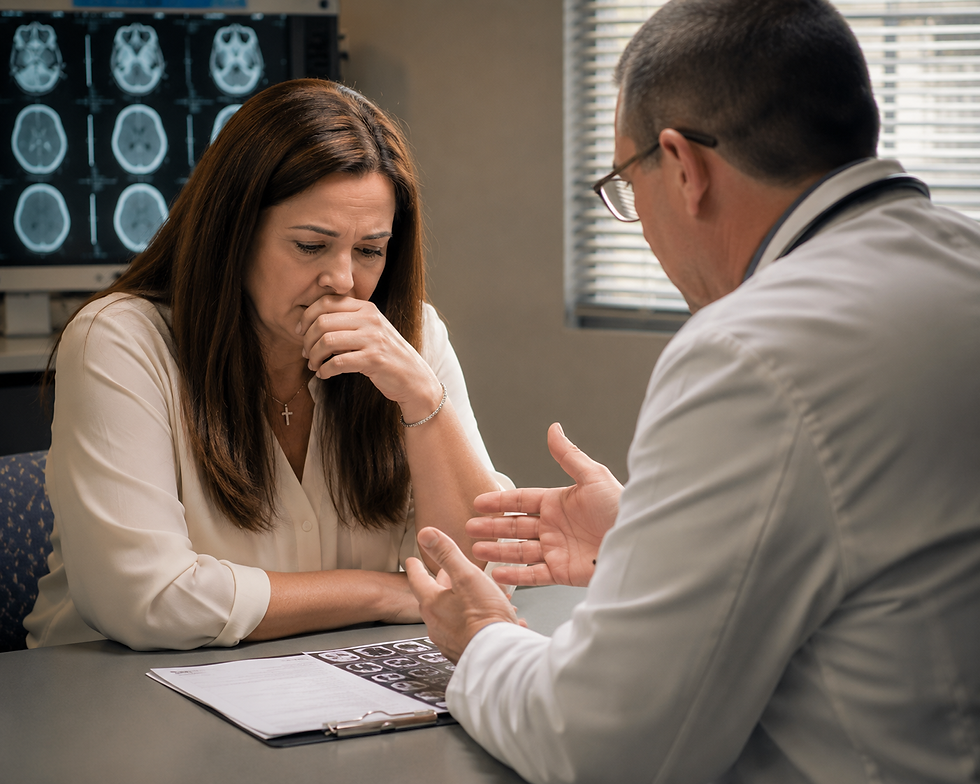
My husband had already endured one frightening health episode months earlier. Doctors discovered a mass on his brain, and our family prepared for devastating news. Yet after additional evaluation, the neurosurgeon told us the mass was gone. We celebrated what we believed was a miraculous healing from God. Relief washed over our family, and within two months, my husband returned to work.
We believed the storm had passed.
Then one morning, he woke up and was not making sense.
His speech was disoriented, and something deep within me knew this was serious. I rushed him to the emergency room, where doctors informed me he was experiencing seizures that were not physically visible from the outside. As his condition rapidly worsened, physicians began discussing options that no wife ever wants to hear.
I was asked whether they should place my husband into a medically induced coma.
Everything around me felt chaotic. Machines beeped constantly. Specialists moved in and out of the room. Medical terminology filled the air. Yet beneath the visible crisis, I sensed something even heavier pressing against us spiritually.
Before the coma was initiated, my husband began hallucinating intensely. His fear became overwhelming. When he spoke about seeing death sitting in the room beside him, something shifted inside of me. I immediately began praying aloud and asking the Holy Spirit to fill every corner of that hospital room.
That moment shook me deeply, but it also awakened something in me spiritually.
I realized I could not allow fear to lead me.
I had to decide whether I would surrender to panic or surrender to God.
Creating Peace in the ICU
As doctors prepared to place my husband into the coma, I felt an unusual clarity from the Lord. While the medical team focused on stabilizing his body, I sensed God calling me to protect the atmosphere surrounding him spiritually.
I began praying over him constantly.

I prayed Scripture aloud. I prayed for peace. I prayed for protection. I prayed for warrior angels to surround him. I prayed that no weapon formed against him would prosper. I prayed that the Holy Spirit would remove every trace of fear from the room.
The intensive care unit was not quiet. It was filled with alarms, movement, urgency, and uncertainty. Yet in the middle of that environment, the presence of God became tangible to me.
There was a large observation window in the room where doctors and nurses often stood watching. At first, I felt uncomfortable praying aloud where everyone could hear me. Part of me wanted to remain quiet and reserved.
But the Holy Spirit kept prompting me to pray anyway.
So I obeyed.
Over time, members of the care team began approaching me with questions. One nurse practitioner in particular would come into the room and comment repeatedly about the atmosphere surrounding my husband.
She told me that most families became so overwhelmed by trauma that their emotions intensified the stress surrounding the patient. She said families often created an environment filled with fear, panic, and confusion.
Then she looked at me and asked, “How are you this calm with everything happening to your husband?”
I remember telling her, “It is not me. It is God.”
That conversation opened the door for many others.
I began realizing that God had not only called me to stand beside my husband during his illness. He had also called me to witness to the people caring for him.
The ICU became more than a place of suffering. It became a place of ministry.
Healed on Earth or Healed in Heaven
Doctors repeatedly prepared me for the worst.
One physician told me directly that they did not know whether my husband would wake up. Another neurologist eventually entered the room and confidently stated that my husband was not going to recover.
I remember rejecting those words immediately.
“I do not come into agreement with that,” I told him.
My faith did not mean I was denying reality. I understood how serious the situation was. I saw the machines. I saw the medications. I saw the uncertainty in the faces of the medical staff.
But I also knew that God alone had the final authority.
There were moments when I prayed and asked God plainly whether my husband would survive. Yet I never felt the Lord clearly tell me which way the outcome would go.
What I did feel was peace.
I reached a place where I understood something deeply: my husband would be healed either on earth or in heaven.
That realization changed me.
Faith is not pretending suffering does not exist. Faith is remaining anchored to God even when outcomes remain uncertain.
During those thirty-five days, I learned how to trust God without controlling the outcome.
The Battle After He Woke Up
Eventually, my husband woke up from the coma.
I thought the hardest part of the journey was over.
I was wrong.
Physically, he was awake. Mentally and emotionally, however, he was not the husband I recognized.
He did not know who he was consistently. He became combative and confused. He hallucinated. He believed people were trying to harm him. Sometimes he acted as though he were in combat, making gestures with his hands like guns and demanding ammunition.
The man sitting in front of me looked like my husband, but he was unreachable emotionally and cognitively.
That reality became more painful for me than the coma itself.
I had prepared myself for the possibility of losing him physically. I had not prepared myself for the possibility of getting him back physically while still losing pieces of who he was.
The medical team informed me they believed he would need to be discharged into a skilled nursing facility because of the severity of his condition.
Yet even during that season, the Holy Spirit continued guiding me moment by moment.
There were brief periods when my husband became lucid. He could occasionally answer questions correctly or recognize family members. I began carefully documenting those moments because something inside me felt unsettled by the dramatic swings in his behavior.
One day, I felt strongly impressed by the Lord that some of what we were seeing might not solely be neurological damage. I resisted the thought initially because I assumed medications and treatments would already be monitored carefully.
Still, I obeyed the prompting.
I started paying close attention to the timing of medications and changes in his behavior. Eventually, through documentation and conversations with staff, we identified medications that appeared to be contributing significantly to the confusion, aggression, and memory loss.
Once adjustments were made, improvements slowly began to appear.
For the first time in days, we could hold a conversation.
Learning Immediate Obedience
Before this trial, I often hesitated when I sensed God speaking to me.
I would question myself.
Was it really God?
Was I overthinking?
Should I wait?
Should I say something later instead?
During those thirty-five days, hesitation disappeared.
The intensity of the situation stripped away my tendency to negotiate with God.
I remember praying constantly, “Holy Spirit, make it simple because I cannot process complexity right now.”
And He did.
Sometimes the instructions were clear and direct.
“Pray over your husband right now.”
“Speak to that nurse.”
“Stay in the room.”
“Do not fear.”
I learned something powerful during that season: delayed obedience weakens spiritual clarity.
In crisis, there was no room for endless analysis or emotional paralysis. I had to respond quickly when God prompted me.
That experience transformed my relationship with obedience permanently.
Even when situations felt uncomfortable or socially awkward, I stopped questioning whether I should act on what God placed in my spirit.
I simply obeyed.
Thirty-Five Days in the Fire
The hospital became our world for thirty-five days.
There were moments when the intensity felt unbearable.
My husband was restrained at times because he would fight the staff unintentionally during periods of confusion. There were moments when multiple people held him down while nurses prepared additional sedation for his safety.
I watched machines surrounding his bed operate at maximum capacity. Medication bags hung from both sides of the room. Feeding tubes, ventilators, and constant medical intervention became part of daily life.
One evening after he had been heavily sedated, I walked back into the room and saw him lying nearly motionless.
He looked lifeless.
For a moment, fear tried to overwhelm me completely.
If the presence of God had not sustained me in that room, I truly believe I would have run out terrified and never been emotionally capable of walking back in.
Instead, God strengthened me to remain present.
That may sound simple, but presence became warfare.
Showing up every day became warfare.
Praying became warfare.
Choosing peace became warfare.
Rejecting hopelessness became warfare.
There was no glamorous leadership in those moments. No audience. No recognition. No platform.
Just obedience.
Just surrender.
Just faith in the middle of uncertainty.
Living with a Different Reality
My husband survived.
That sentence carries both gratitude and grief.
Today, he remembers our family and can hold conversations, but life is very different than it once was. He cannot drive safely. His short-term memory is significantly affected. He becomes overstimulated easily and sometimes struggles to recognize danger appropriately.
At times, people who interact with him briefly think he is completely fine. Those who spend extended time with him recognize the lasting effects of what happened.
There was a season when I wrestled emotionally with the reality that healing did not look the way I imagined it would.
Yet God continued teaching me even there.
Not every miracle arrives wrapped in complete restoration. Sometimes God gives grace to sustain what remains.
I had to learn how to lead our family through a “new normal” while still trusting God fully.
That required another level of surrender.
What the Fire Revealed
Looking back now, I understand that God was refining me during those thirty-five days.
He taught me how to remain focused on Him when chaos surrounded me.
He taught me that fear and confusion are tools the enemy often uses to weaken discernment and steal peace.
He taught me the importance of spiritual authority inside my own home and family.
Most importantly, He taught me that obedience matters more than comfort.
Before this experience, I often second-guessed whether God truly wanted me to speak, pray, or step forward in certain moments.
Now, when He prompts me, I move.
The fire changed me.
It deepened my faith. It strengthened my discernment. It increased my sensitivity to the Holy Spirit.
Most of all, it showed me that God can use even the most painful seasons to reveal His presence to others.
The ICU room became holy ground.
Not because suffering was good, but because God met us there.
And even in the fire, He remained faithful.
LEADERSHIP LESSONS
Peace is not the absence of chaos. True peace is the presence of God in the middle of uncertainty.
“You will keep in perfect peace those whose minds are steadfast, because they trust in you.” — Isaiah 26:3 (NIV)
Fear and confusion are often weapons used during spiritual battles. Discernment requires remaining anchored to God’s voice instead of emotional panic.
“For God is not the author of confusion but of peace.” — 1 Corinthians 14:33 (NKJV)
Delayed obedience weakens spiritual clarity. Leadership during crisis often requires immediate response to God’s direction.
“Whether you turn to the right or to the left, your ears will hear a voice behind you, saying, ‘This is the way; walk in it.’” — Isaiah 30:21 (NIV)
God may use your personal trial as an opportunity to disciple and minister to others watching your response.
“And the things you have heard me say in the presence of many witnesses entrust to reliable people who will also be qualified to teach others.” — 2 Timothy 2:2 (NIV)
Healing does not always look the way we imagined, but God remains faithful through every stage of the journey.
“My grace is sufficient for you, for my power is made perfect in weakness.” — 2 Corinthians 12:9 (NIV)
Author Bio
Angie Conner is the Founder of Kingdom Growth, a Christian author, speaker, and faith-based coach who serves Christian Gen X and midlife women navigating unexpected seasons of change. Her 30-year corporate career building and leading enterprise sales teams taught her how to lead through transition, while her personal journey taught her how to live through it.
After experiencing job loss, caregiving, her husband’s life-threatening illness and disability, and growing family responsibilities, Angie discovered a lasting truth: when the plan changes, purpose does not disappear.
Her work is grounded in Matthew 6:33 and the NEXT framework: Name what changed, Examine what remains, eXplore what is possible, and Take the next faithful step. Through books, devotionals, podcast conversations, speaking, coaching, and digital resources, she combines honest storytelling, Scripture-centered encouragement, practical tools, and decades of leadership experience.
Angie helps women move forward without minimizing what they have experienced. Her areas of focus include caregiving, family transitions, job loss, identity shifts, midlife purpose, reinvention, and faith-centered growth.
Kingdom Growth is operated by Kingdom Growth Advisors LLC.
Learn more at kingdomga.com.


Comments